
Probabilistic Thinking
Decisions or predictions are based on probabilities rather than certainties, we should therefore acknowledge the influence of randomness and uncertainty.
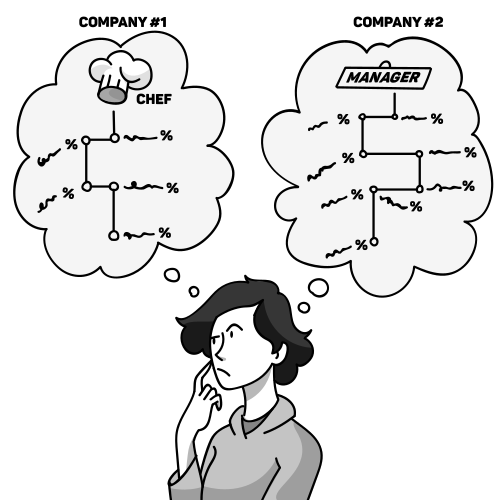
Probabilistic Thinking is about embracing the complexity of real-world situations by understanding that most outcomes are not black or white but fall somewhere on a spectrum of probabilities. This mental model encourages us to evaluate decisions and make predictions not on absolute certainties but on the likelihood of various outcomes. It's rooted in the mathematical field of probability, which has been studied and developed since the 17th century by mathematicians like Pierre-Simon Laplace and Blaise Pascal. These pioneers laid the groundwork for thinking in terms of chances and likelihoods, which is crucial in fields ranging from weather forecasting to financial investing. Probabilistic Thinking involves estimating the chances of different outcomes, often based on incomplete information, and making decisions that account for these varied possibilities and the degree of uncertainty involved with each.
Example
Investing
Instead of assuming a stock will definitely go up or down, you assess the probabilities of various performance scenarios. Why? This helps in diversifying your portfolio based on risk tolerance and potential returns.
In your professional life
Use Probability in Project Planning
When planning a project, think about different things that could happen and how likely each is. For example, a builder might say: "There's a 60% chance we finish on time, 30% chance we're a week late, and 10% chance of a two-week delay." This helps everyone understand what to expect.
Go deeper in ThinkBetter
ThinkBetter is the app for mental models and cognitive biases. For Probabilistic Thinking, the free version includes more than this page — further examples, a quiz, audio, and a weekly path — and every model and bias in the library. Pro is an optional, inexpensive upgrade for the rest of the deep-dive.