
Loss Aversion Bias
We often feel the pain of losing something more intensely than the pleasure of gaining something of equal value.
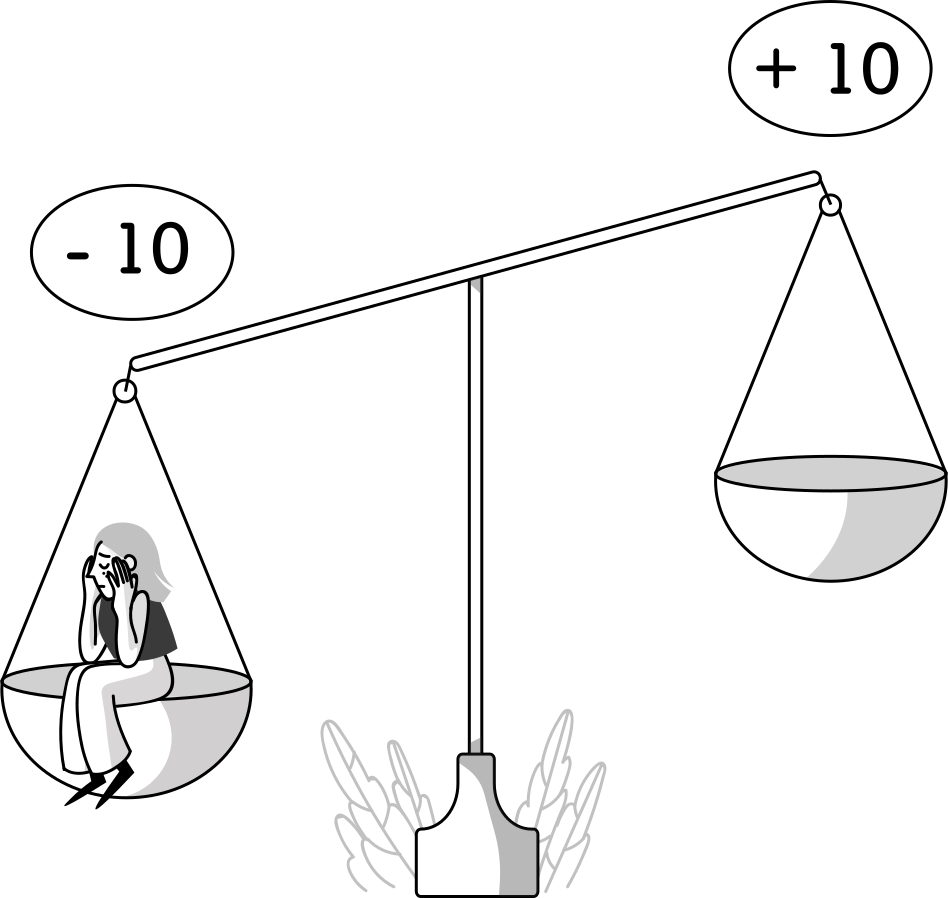
At the heart of Loss Aversion Bias is our innate psychological tendency to prefer avoiding losses than having gains, even if they are perfectly equal. It's like our brains have this in-built alarm system that sounds the sirens louder when we're about to lose something, compared to when we're on the brink of a win. For instance, the disappointment or discomfort we feel from losing $10 seems to have a much stronger emotional impact than the happiness or satisfaction derived from gaining the same $10. This isn't just limited to money. It could be opportunities, possessions, relationships, or anything we value — we just react worse to losing something than gaining *that same something*.
Example
Clearance Sale
You buy clothes you don't need just because they're on sale, thinking more about the money you're 'saving' than the money you're spending. Why? The pain of losing a 'deal' feels greater than the benefit of saving money by not buying at all.
In your professional life
Project proposals and pitches
Frame your proposals in terms of potential losses avoided rather than gains achieved. For instance, instead of saying "This initiative could increase efficiency by 20%," try "Without this initiative, we risk losing 20% of our potential efficiency." This approach can increase stakeholder buy-in by emphasizing the urgency of action.
Go deeper in ThinkBetter
ThinkBetter is the app for mental models and cognitive biases. For Loss Aversion Bias, the free version includes more than this page — further examples, a quiz, audio, and a weekly path — and every model and bias in the library. Pro is an optional, inexpensive upgrade for the rest of the deep-dive.