
Survivorship Bias
The focus on successful outcomes while overlooking failures due to their lack of visibility.
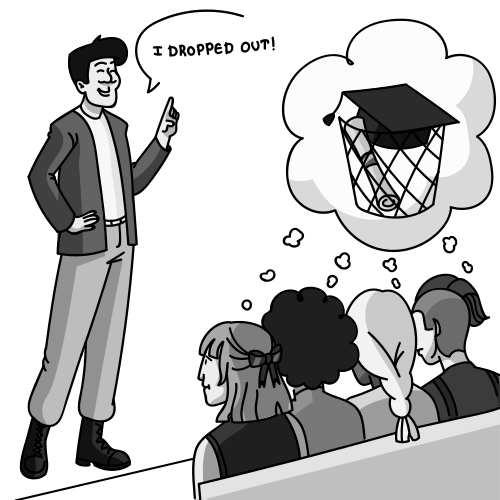
Imagine looking at a group of successful individuals in any domain - be it business, sports, or arts. The common narrative might focus on what these individuals did right. But what about those who followed the same strategies and didn't succeed? Their stories often remain untold. You might have a few biographies of successful business people who all dropped out. And you might think ****that**** is the way to succeed. But what about everyone else that also dropped out but isn’t successful? And had perhaps very different outcomes. Survivorship bias occurs when we base our understanding or decisions only on the visible successes, neglecting the lessons that can be derived from failures or simply the unseen. And in today’s world the success is often times amplified and a lot more visible than the failures.
Example
Entrepreneurial Ventures
Just because certain entrepreneurs dropped out of college and became successful doesn't mean everyone should. For every dropout success story, there might be countless others who regretted the decision. Why? Focusing only on the successes can give a skewed perception of the reality of the entrepreneurial world.
In your professional life
Learn from Both Sides of the Coin
When studying successful strategies or individuals in your field, also research those who didn't succeed to gain a balanced perspective. For example, if you're analyzing successful product launches in your industry, look into similar products that failed as well. This comprehensive approach can help you identify critical success factors and potential pitfalls more accurately. By understanding both outcomes, you'll be better equipped to navigate your own projects and career decisions.
Go deeper in ThinkBetter
ThinkBetter is the app for mental models and cognitive biases. For Survivorship Bias, the free version includes more than this page — further examples, a quiz, audio, and a weekly path — and every model and bias in the library. Pro is an optional, inexpensive upgrade for the rest of the deep-dive.