
Narrative Fallacy
We have a tendency to create stories to explain events, even when the events are random or unconnected.
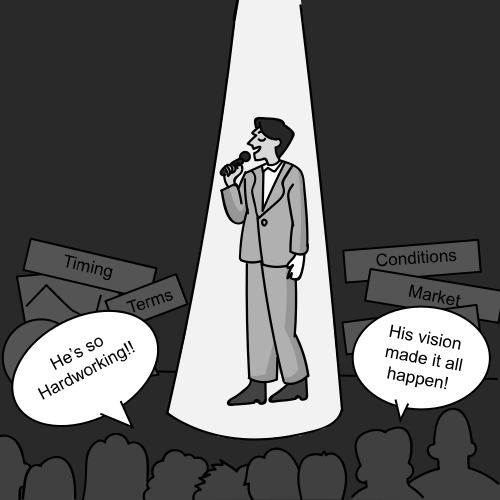
The narrative fallacy describes our brain's inclination to weave disparate facts and events into coherent stories, even when there's no real connection between them. This bias was popularized by Nassim Nicholas Taleb in his 2007 book "The Black Swan."
The narrative fallacy is deeply rooted in how our brains process information. We're pattern-seeking creatures, and stories are essentially patterns of events. This tendency likely evolved as a survival mechanism, helping our ancestors make quick sense of their environment. However, in our complex modern world, this same tendency can lead to misunderstandings and poor decision-making.
Interestingly, the narrative fallacy doesn't just affect how we interpret past events - it also influences how we predict future outcomes. We tend to create stories about what might happen based on our understanding of past events, which can lead to overconfidence in our ability to foresee the future.
Example
Career Success
You attribute a colleague's promotion solely to their work ethic, ignoring factors like luck or timing. Why? It creates a simple, motivating story about success through hard work.
In your professional life
Data-Driven Transparency
When reporting project outcomes, present raw data alongside your interpretation. As a business analyst, provide both statistics and your analysis in presentations. Show actual sales numbers from a recent campaign, then offer insights on market trends influencing the results. This approach demonstrates transparency and analytical skills, allowing others to draw conclusions while benefiting from your expertise. It builds trust with stakeholders and positions you as a credible information source, potentially leading to increased responsibilities.
Go deeper in ThinkBetter
ThinkBetter is the app for mental models and cognitive biases. For Narrative Fallacy, the free version includes more than this page — further examples, a quiz, audio, and a weekly path — and every model and bias in the library. Pro is an optional, inexpensive upgrade for the rest of the deep-dive.