
Availability Heuristic
People tend to rely on immediate examples that come to mind when evaluating something.
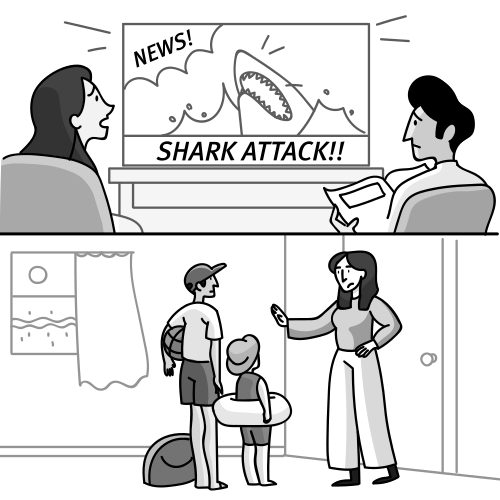
The Availability Heuristic is a mental shortcut that relies on immediate examples that come to a person's mind when evaluating a specific topic, concept, method, or decision. Introduced by psychologists Amos Tversky and Daniel Kahneman in 1973, this heuristic occurs because easily recalled or vivid memories are often mistaken for being more common than they are. For example, people might overestimate the likelihood of plane crashes if they recently read a news article about a crash. The availability of such information in one's memory makes it seem disproportionately important or common, which can skew perception and judgment.
Example
Risk Perception After News Reports
After watching news reports about shark attacks, a family might cancel their beach vacation due to fear, even though such attacks are extremely rare. Why? The recent and vivid reports make the threat seem larger than it statistically is.
In your professional life
Log Work Issues for Accuracy
Keep a log of various types of issues encountered in your work to ensure you're not overestimating the frequency of recent or memorable problems. For example, if you’re a software developer, maintain a record of different bugs and challenges you encounter. This helps you see a comprehensive picture of recurring issues and avoid the bias of focusing only on recent or standout problems.
Go deeper in ThinkBetter
ThinkBetter is the app for mental models and cognitive biases. For Availability Heuristic, the free version includes more than this page — further examples, a quiz, audio, and a weekly path — and every model and bias in the library. Pro is an optional, inexpensive upgrade for the rest of the deep-dive.