
Salience Bias
We tend to focus on the most noticeable or striking features of a situation, often overlooking other important aspects.
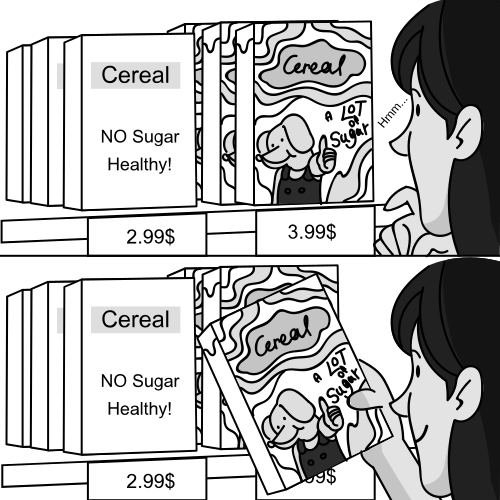
The Salience Bias is a cognitive bias where our attention is naturally drawn to what stands out the most in our environment or information set. Essentially, it's like our brain has a built-in spotlight that automatically highlights the most prominent or unusual elements, making them seem more important or relevant than they might actually be. We tend to overestimate the significance of eye-catching details and underestimate the importance of less noticeable ones. Think of it like being at a party and only remembering the person with the bright red hat, even though there were many other interesting people there!
Example
News Coverage
You hear about a plane crash and become afraid of flying, even though car accidents are statistically more common. Why? The dramatic nature of plane crashes makes them more salient, overshadowing the more frequent but less newsworthy car accidents.
In your professional life
Use Visual Cues to Highlight Key Information
When presenting data or reports, highlight key information using visual cues such as bold text, different colors, or larger font sizes. This could be as simple as emphasizing the most important metric in a financial report or using a contrasting color for critical deadlines in a project timeline. By making certain elements stand out, you can guide attention to the most crucial information, potentially leading to more informed decision-making and efficient communication.
Go deeper in ThinkBetter
ThinkBetter is the app for mental models and cognitive biases. For Salience Bias, the free version includes more than this page — further examples, a quiz, audio, and a weekly path — and every model and bias in the library. Pro is an optional, inexpensive upgrade for the rest of the deep-dive.